

When you start writing seriously, you quickly run into a strange problem. Story structure. You scratch your head, asking: “What does that even mean?” Or, maybe if you’re not an autistic philosopher like I am, you start by looking at examples.
Three-act. Save the Cat. Hero’s Journey. Story Grid.
It sounds like you’re supposed to pick one, follow it, and suddenly your story works.
It doesn’t work like that. And once you learn that, you might fall into the opposite extreme: nearly passing out from anxiety because you can’t remember all of them, and what if you missed one?
You might not need to be able to cite all of them as if writing your novel is like taking an exam. But reading about them, knowing of them—that will be useful, I promise. And that is exactly what this article is about. So let’s dig in, and make you more confident about structure.
Before We Start: What These Frameworks Actually Are
Most writers use these terms as if they mean the same thing. First, let me explain to you what each of these mean.
Structure is the shape of your story — how it moves through time. A framework is a model for understanding or building that shape. A beat sheet is a specific list of turning points. Scene-level tools are what keep individual chapters from dying on the page.
You can have a solid three-act structure and still have scenes that go nowhere. You can follow every beat in Save the Cat and still have a protagonist nobody cares about. The frameworks operate at different levels. This matters.
The Foundations: Big-Picture Story Shapes
These are the skeleton. Everything else — character work, pacing, scene craft — are the muscles and skin.
1. Three-Act Story Structure
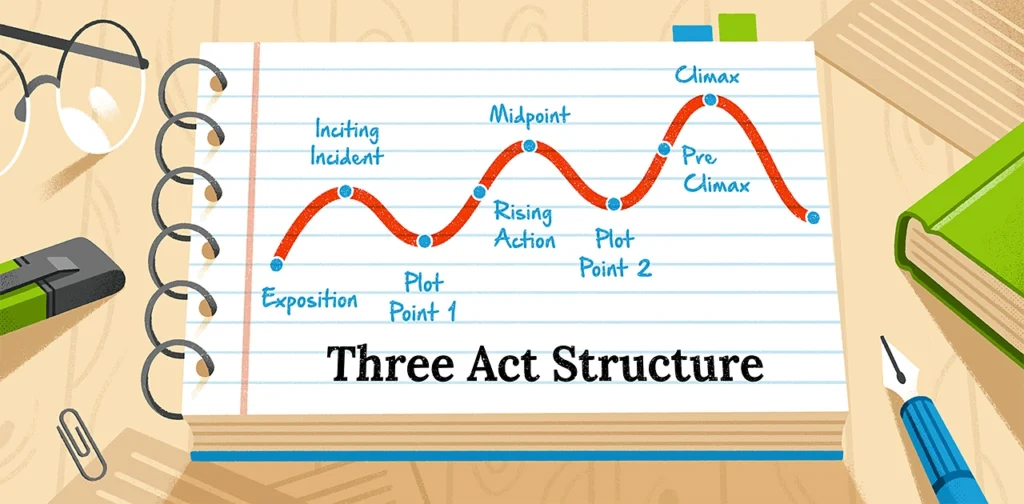
Everyone starts here. And almost everyone finds it useless for the same reason.
Three acts: setup, confrontation, resolution. You read that, you nod, you go back to your manuscript and you still have no idea what’s wrong with chapter fourteen.
That’s not your fault. Three-act structure is not a writing tool. It’s a description. It tells you that a story has a beginning, a middle and an end — which, yes, thanks, incredibly helpful. What it doesn’t tell you is why your middle feels like wading through wet concrete, or why your ending lands with a thud instead of landing at all.
So why is everyone still talking about it?
Because it describes something real. There is a before, and there is an after. There is a world your character inhabits at the start, and a world — or a version of themselves — that is fundamentally different by the close. That shift is the story. Three-act structure is just the clumsiest possible way of naming it.
Where it actually becomes useful: not as a planning tool, but as a diagnostic one. When something feels off in a draft, one of the first questions worth asking is whether Act I is doing its actual job — which is not to introduce your character, but to establish what they stand to lose. And whether Act III is a genuine consequence of Act II, or just an ending you bolted on because the story needed to stop somewhere.
If your Act II is sagging — and it will sag, it sags for everyone — three-act structure won’t fix it. But it will at least tell you that the problem exists. For the fix, you’ll need something else. More on that shortly.
Use it for: stepping back and asking whether your story has a real before and after, or just a sequence of events.
Don’t use it for: actual scene-by-scene planning. It’s too vague to help with that.
2. Four-Act Story Structure
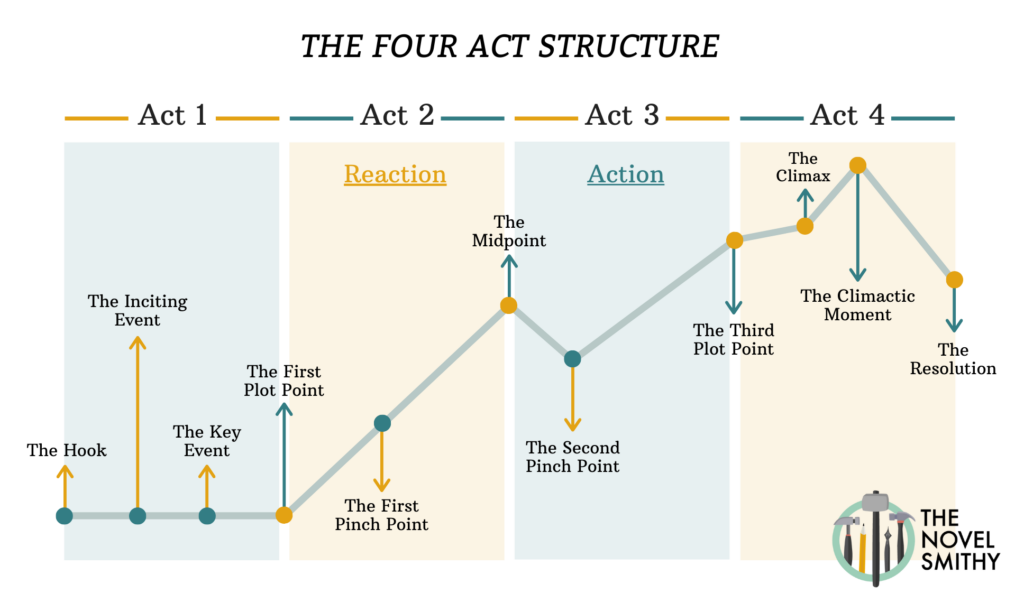
This is what people usually reach for when they realise three-act structure is technically true and practically unhelpful.
Because yes, stories have a beginning, middle, and end. But that middle is where novels go to die.
Four-act structure fixes that by admitting something writers already know in their bones: the middle is not one thing. It is two very different kinds of movement pretending to be the same section.
Act I is still the beginning. Fine.
Act IV is still the ending. Also fine.
The difference is what happens in between.
The first half of the middle is usually reaction. Your character is dealing with the consequences of the story kicking them in the teeth. They are adjusting, denying, improvising, making bad decisions, clinging to old assumptions a little longer than they should. The second half is different. That is where they stop merely enduring the story and start moving into it with intention. Something has shifted. They may still be wrong, but at least now they are wrong on purpose.
That split is the whole point.
And once you see it, a lot of broken manuscripts suddenly become easier to diagnose.
Because sometimes the problem is not that your middle is too long. The problem is that your character is stuck in the same emotional or strategic mode for two hundred pages. They keep reacting. They keep scrambling. They keep learning the same lesson in slightly different outfits. Or the opposite: they start acting with confidence before the story has actually cornered them enough to earn that shift.
This is why four-act structure is more useful than three-act structure for actual novel work. It gives shape to the murkiest part of the book. It lets you ask:
- Is my character still in reaction mode?
- Have they crossed into a more active, committed phase?
- Is there a real turn in the middle, or just more pages?
That midpoint turn matters more than people think. It does not need to be loud. It does need to change the temperature. A discovery. A betrayal. A wrong decision made consciously. A new piece of knowledge that can no longer be ignored. Something that makes the second half of the novel behave differently from the first.
If that shift never comes, the book starts to feel swampy.
Readers may not be able to name the issue, but they feel it. The story keeps moving, technically, yet somehow nothing deepens. The character is busy, the plot is busy, everyone is sweating, and still the novel feels oddly static.
That is usually a four-act problem.
Where this structure becomes especially useful is in revision. It helps you divide the middle into two different jobs:
Middle, part one: destabilise the character.
Middle, part two: force them to move differently.
Those are not the same thing, and your book gets stronger the moment you stop treating them as if they are.
Use it for: fixing a sagging middle, checking whether your midpoint actually changes anything, making sure your character’s mode of action evolves.
Don’t use it for: pretending structure alone will solve a dull story. If the character wants nothing and risks nothing, no number of acts will save you.
3. Freytag’s Pyramid Story Structure

This is one of those story structure terms that sounds far more academic than it really is. Exposition, rising action, climax, falling action, resolution. Most writers hear that and immediately think of something stiff, old-fashioned, maybe useful for Shakespeare essays and not much else.
That would be a mistake.
Freytag’s Pyramid is actually useful when your draft has events, but not enough pressure. It reminds you that a story is not just a sequence of things happening. It is a sequence of things becoming harder to avoid. The rising action is not there to “fill pages before the climax.” Its job is to tighten the vice. Each scene should make the central problem more difficult, more intimate, or more expensive. If your middle feels flat, this writing framework gives you a simple question to ask: is the tension actually rising, or am I just adding more activity?
It is also good at exposing weak climaxes. A climax only works when it feels like something has been forced to break. If the big moment arrives and feels oddly light, or decorative, or like a scene that was always going to happen no matter what came before, Freytag helps you see the issue. Usually the problem is not the climax itself. Usually the pressure leading up to it was not built properly.
One part of this story structure that modern writers often rush past is the falling action. We like impact. We like endings. We are less patient with aftermath. Freytag makes room for consequence. What changed because of the climax? What is broken now? What does the character have to live with? If your ending feels abrupt, thin, or emotionally undercooked, you may not need a different ending. You may just need to let the story breathe for a few pages after the breaking point.
Use it for: checking whether your tension is genuinely escalating, whether your climax feels earned, and whether your ending allows enough room for consequences to land.
Don’t use it for: scene-by-scene outlining. Like three-act structure, it is better as a diagnostic writing framework than as a planning method.
4. Fichtean Curve Story Structure
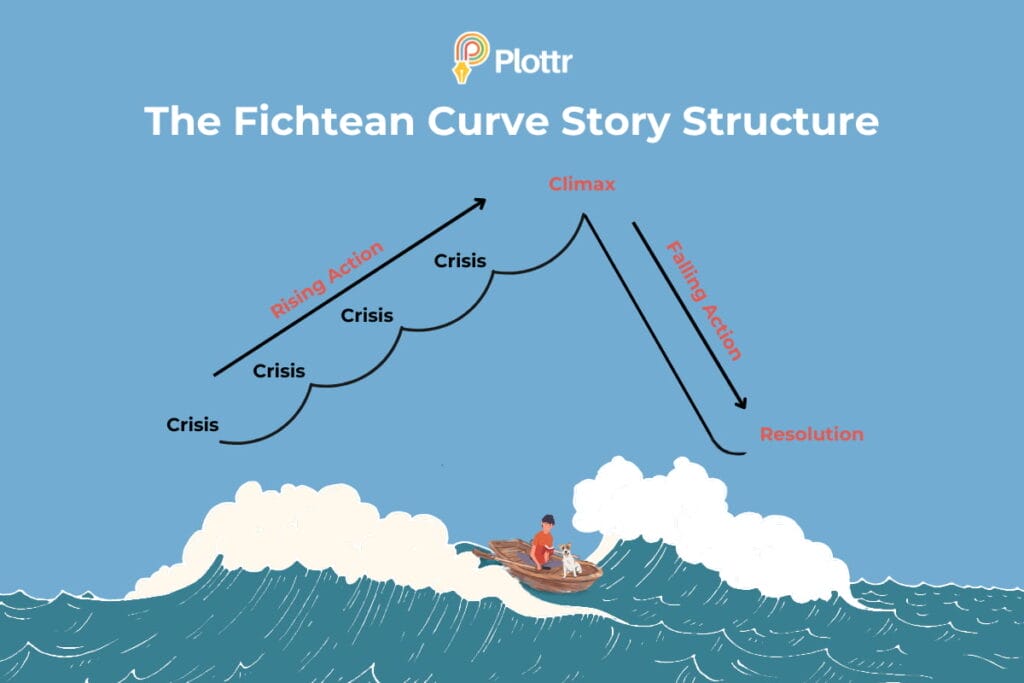
This is the story structure people quietly gravitate toward when they’re tired of slow beginnings.
It skips the long setup and gets straight into trouble. You start near the tension, not miles before it. Something is already off, already unstable, and the story keeps tightening from there.
That sounds appealing, especially if your drafts tend to drift. But it also exposes a different kind of weakness.
Because once you remove the slow build, you lose your safety net. There is no time to “warm up.” Every scene has to carry weight immediately. If it doesn’t, the pacing doesn’t just feel slow. It feels empty.
What I’ve noticed when using this writing framework is that it forces you to think in terms of escalation, not progression. Things can’t just move forward. They have to get worse, or more complicated, or more irreversible. If your character solves a problem too cleanly, the story loses pressure. If they avoid the problem entirely, the tension leaks out.
It also changes how you think about chapters. Instead of asking “what happens next,” you start asking “what makes this harder?” That one shift can fix a surprising number of flat scenes.
The risk is that everything starts to feel equally intense. If every moment is urgent, nothing stands out. You still need variation. Quieter moments, not for rest, but for recalibration. Otherwise the story becomes noise.
Use it for: tightening pacing, especially if your opening drags or your middle feels like it’s stalling. It’s a strong story structure when you want momentum to carry the reader.
Don’t use it for: forcing constant intensity without direction. As a writing framework, it breaks quickly if escalation is random or if the character isn’t being pushed into meaningful decisions.
5. Kishōtenketsu Story Structure
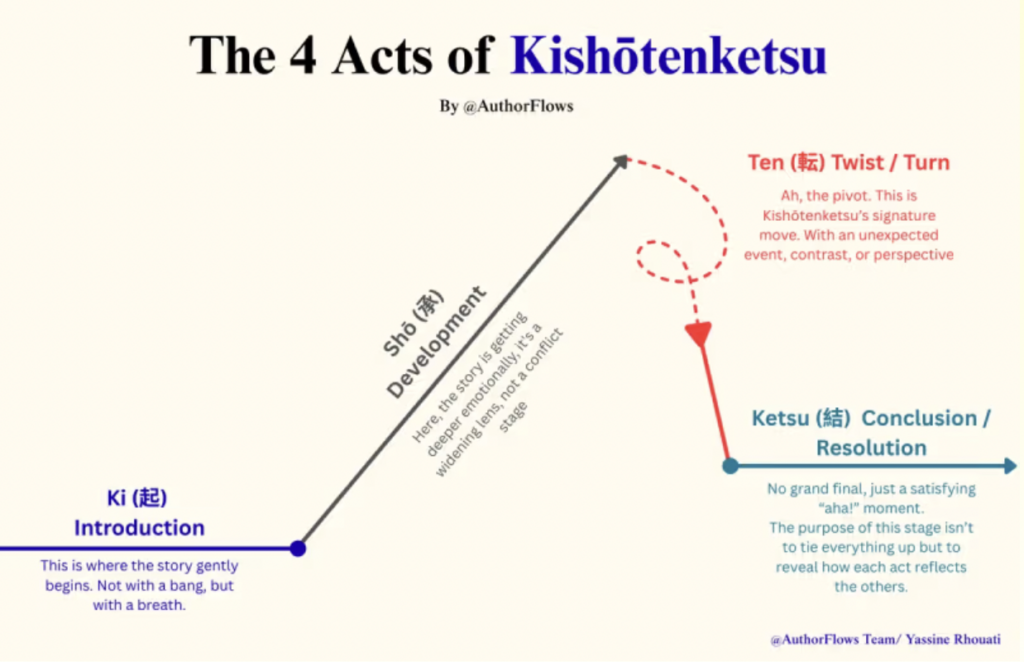
This is the story structure that tends to confuse people at first, mostly because it does not behave the way we expect.
There is no central conflict driving everything forward. No constant escalation. No obvious antagonist shaping the movement of the story.
Instead, it moves through four parts. Introduction, development, a shift, and then a resolution. The shift is the interesting part. Something changes the perspective. Not necessarily through confrontation, more through contrast.
That can feel strange if you are used to thinking in terms of tension and stakes. It can even feel like nothing is happening.
Until you realise something else is happening.
The focus is not on pressure building. It is on meaning emerging. You are not watching a character fight their way through obstacles. You are watching pieces of the world sit next to each other until they create something new.
This writing framework becomes useful when a story feels forced. When every scene is trying too hard to create conflict, and the result is noise instead of depth. Sometimes the issue is not that there is too little happening. It is that everything is happening in the same way.
Kishōtenketsu gives you another option. Let the story unfold. Let two ideas, or two moments, or two versions of a character exist side by side. Then introduce something that reframes both.
The risk is obvious. Without pressure, the story can drift. It can become passive, or vague, or simply uninteresting. This structure asks more from the reader. It also asks more discipline from the writer. You have to trust that the shift will land, and you have to place it carefully enough that it changes how everything before it is seen.
It works best when you are writing something quieter, or more reflective, or slightly off-centre. Not everything needs to be driven by conflict. But if you remove conflict, you need something else that holds the story together.
Use it for: stories where contrast, theme, or perspective matter more than direct confrontation. It is a useful story structure when you want the reader to arrive at meaning rather than be pushed into it.
Don’t use it for: trying to fix a lack of tension by removing tension entirely. As a writing framework, it will not save a story that has no movement or no underlying idea holding it together.
The Character Frameworks
These don’t care about plot as much as they care about change.
6. The Hero’s Journey
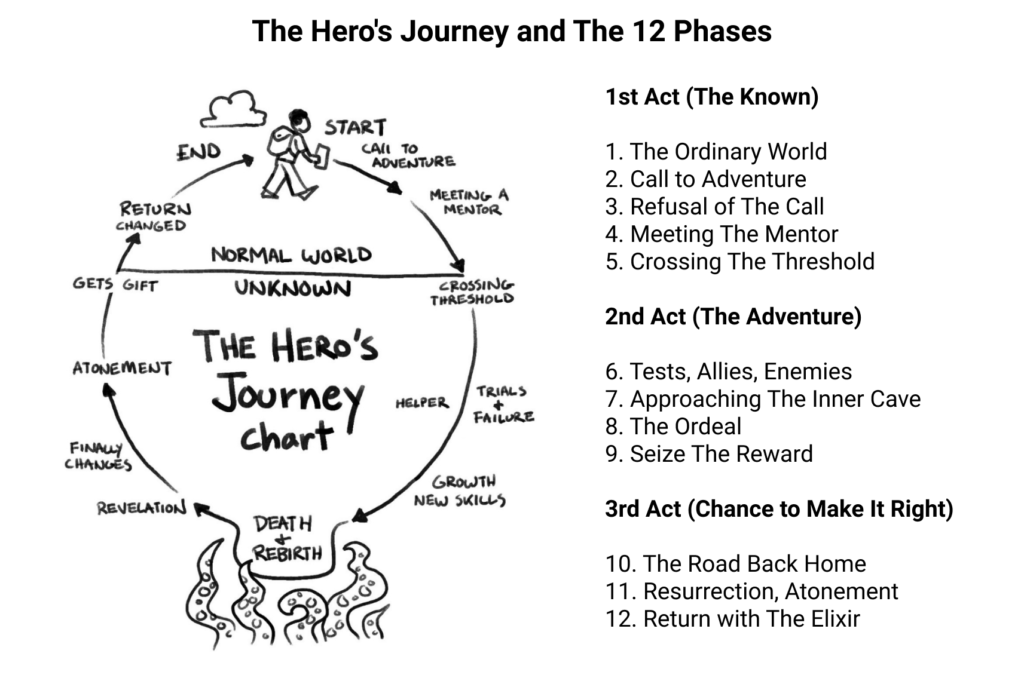
The Hero’s Journey is probably the most famous story structure in modern writing advice, which is partly why writers either cling to it too hard or reject it too quickly. Both reactions miss the point. The value of this writing framework is not in its named stages, and certainly not in trying to force your novel through every one of them like a passport control line. Its value is that it understands story as a movement of separation, ordeal, and return. A character leaves the known world, enters a space that tests them, and comes back altered, if they come back at all in any meaningful sense. That is older than craft books. It is mythic because it keeps happening.
What makes it useful for novelists is not the mythology itself, but the pressure it puts on character change. A lot of drafts have events, danger, even good pacing, but the protagonist is still emotionally standing in the same place at the end as they were at the start. They may have learned information. They may have won or lost. But they have not crossed any inward threshold that matters. The Hero’s Journey gives you a harsher question than “what happens next?” It asks what the story is taking from your character, what false self or safe identity they can no longer keep once the ordeal is over. If the answer is “not much,” the story may still function, but it will feel lighter than it should.
This story structure is especially good at exposing weak middles and overly tidy endings. The middle, in this framework, is not just a chain of obstacles. It is where the old logic stops working. The character cannot keep relying on the habits, beliefs, or protections that made sense in the world they came from. And the ending should not feel like a clean restoration of balance unless restoration itself is the point. Return matters because the person returning is no longer the same person. If your ending slides too easily back into normality, or if the transformation feels cosmetic, the Hero’s Journey helps you see what is missing: the passage through the story did not cost enough.
Where writers get into trouble is by treating it as a template instead of a diagnostic. They start hunting for mentors, thresholds, belly-of-the-whale moments, as if the structure exists to be spotted rather than felt. That usually makes the writing stiff. What matters is not whether you can label the moment correctly. What matters is whether the novel carries the deeper movement this writing framework is built on: departure, disorientation, change, return.
Use it for: testing whether your protagonist has truly crossed out of one state of being and into another, and whether the ending reflects that change with enough weight.
Don’t use it for: outlining by mythic checklist. The moment it becomes too literal, it starts flattening the very thing it is supposed to deepen.
7. Dan Harmon’s Story Circle
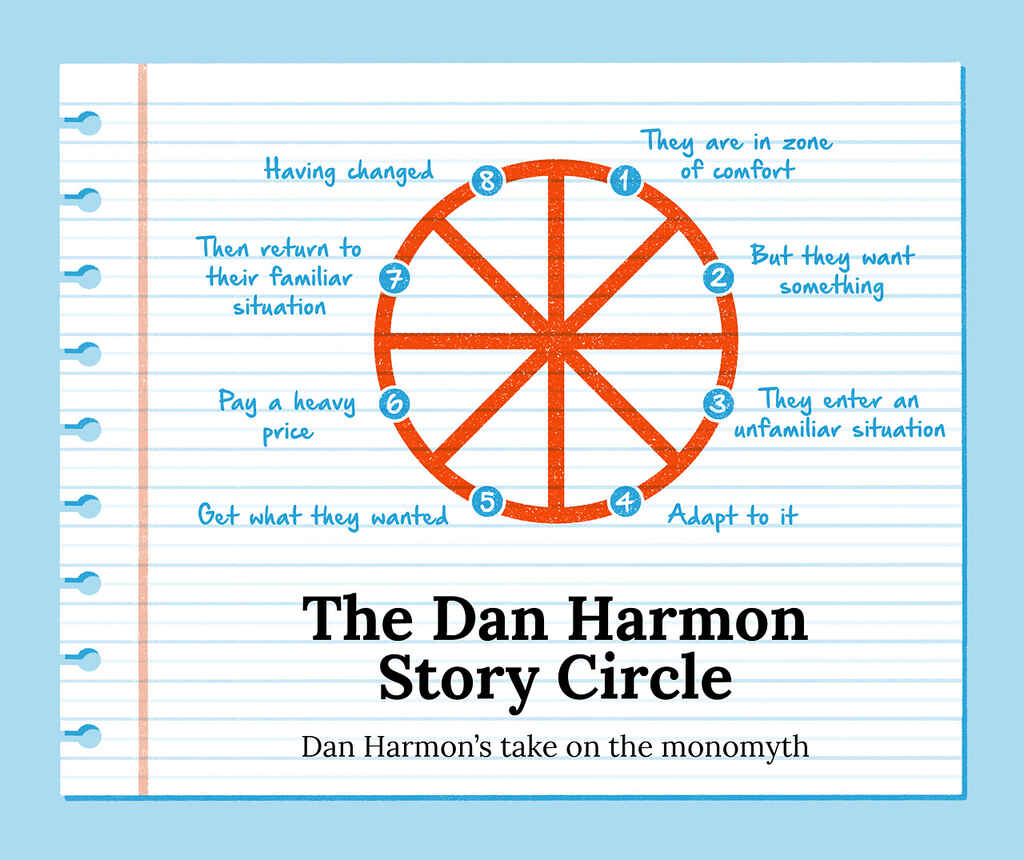
This is one of the few story structure models that actually feels usable once you’re inside a messy draft.
On paper it looks simple. Eight steps. A loop. You, need, go, search, find, take, return, change. You can write it in the margin and feel like you understand it.
The usefulness shows up later, when something in your story feels slightly off and you cannot quite explain why.
What this writing framework does well is force you to track movement, not just events. It makes you look at where your character starts, what disrupts that state, and whether they ever really leave it. More importantly, it tracks what happens after they get what they thought they wanted. That part is often underwritten.
A lot of drafts have a clear beginning and a clear goal. The character wants something, goes after it, faces resistance. Then they get it, or get close to it, and the story starts to lose shape. The ending arrives, but it does not feel like a consequence of what came before. It feels like a stopping point.
The circle is helpful there because it insists on a cost.
Not just effort. Not just struggle. A trade. The character finds something, but they do not keep everything they had before. Something is lost, or shed, or exposed. And when they return, the return is not a reset. It is a shift in how they exist in the same space.
That is the part that tends to be missing when a story feels complete on the surface but hollow underneath. The character moved through the plot, but the experience did not rearrange them in any meaningful way.
It is also useful for pacing. If your middle feels like it is dragging, it is often because the character is stuck in one part of the circle for too long. They are searching without finding, or reacting without committing, or circling the same decision without crossing into action. This framework gives you a way to see that stall without needing to map every scene.
The risk is similar to other structured models. If you start trying to label each beat while writing, the story stiffens. It becomes aware of itself. The circle works better as something you check against after you have material, not something you try to perform while drafting.
Use it for: checking whether your character actually moves through a full cycle of change, especially whether the “return” reflects a real cost or shift. It is a practical story structure when your ending feels slightly unearned or your middle feels stuck.
Don’t use it for: forcing your story into eight visible steps. As a writing framework, it is strongest when it stays slightly in the background and you use it to notice where the movement breaks down.
The Plotting Systems
These are the tools you use when staring at a blank page.
8. Save the Cat Story Structure
This is probably my personal favorite story structure, and the one I find myself using the most while working on my dystopian novel, Other Island.
Not because it is the deepest writing framework ever invented. It isn’t. And not because I think stories should be engineered into identical shapes. They shouldn’t. I keep returning to it because when a draft starts to sprawl, or the middle begins to lose pressure, or I can feel that something is structurally off but can’t yet name it, this is often the framework that helps me see the problem fastest.
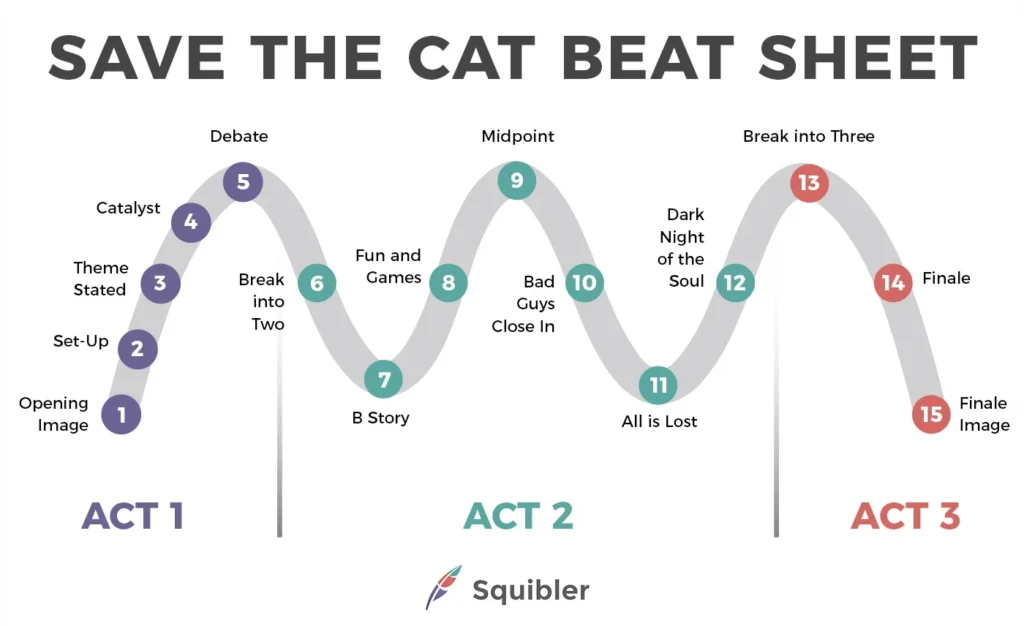
That is really where Save the Cat is strongest. It gives you something concrete to test against. Specific beats, clear turning points, an actual spine. If you have a promising premise, a few strong scenes, and a character you care about, but the story still feels loose in your hands, this structure can be incredibly clarifying. It helps you see whether the book is truly moving, or whether it is just accumulating pages.
What I especially like about it is how well it exposes weak turning points. The midpoint, for example, cannot just be “something happens in the middle.” It has to shift the temperature of the story. The same goes for the dark moment before the ending. If those turns are soft, the whole draft starts to feel softer than it should. I’ve found this especially useful in dystopian fiction, where atmosphere can carry you for a while, but eventually the story still needs to tighten, pivot, and make the character pay for the path they’re on.
That said, it is very easy to use Save the Cat too literally. The moment you start writing toward beats instead of writing toward what feels true, the story begins to lose some of its pulse. You can hit every structural checkpoint and still end up with something flat, predictable, or emotionally thin. So I do not treat it like law. I treat it more like a diagnostic map. It helps me see where the pressure drops, where the story has failed to turn sharply enough, and where the ending has not been properly earned.
Use it for: giving shape to a draft that feels messy, especially if you need help strengthening the middle and sharpening major turning points. It is one of the most practical story structure tools I know, and for me it has been especially useful while writing Other Island.
Don’t use it for: forcing every novel into the same rhythm. As a writing framework, it works best when it helps you notice what your story needs, not when it starts telling your story who it has to be.
And just as a side note, the book itself includes what they call the “not-your-mother’s genres,” which is one of the more useful parts people tend to overlook. Things like Monster in the House, Golden Fleece, Dude with a Problem, Institutionalized, Rites of Passage. They’re less about surface genre and more about the underlying story engine. Once you figure out which one your story falls into, the structure tends to get much clearer, because you’re no longer trying to solve a generic problem. You’re solving a very specific kind of story.
If you end up using Save the Cat even a little, it’s worth spending some time on their official website. It’s not just marketing for the book. They have practical tools that can actually help when you’re stuck, especially beat sheets, breakdowns of well-known films and novels, and examples of how the structure shows up in real stories. Seeing a finished story mapped onto the beats can make the whole thing click in a way the theory alone sometimes doesn’t.
9. Seven-Point Story Structure
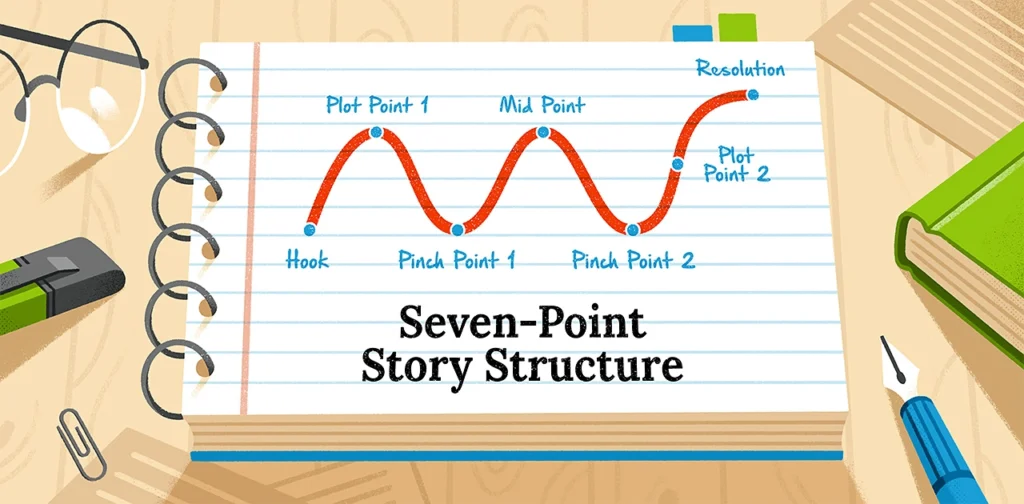
This is one of those story structure models that doesn’t get as much attention as Save the Cat, but ends up being more flexible once you actually start working with it.
It’s built around a few key points. Hook, plot turn, pinch points, midpoint, resolution. Not many moving parts, which is part of why it works. It doesn’t try to control every beat. It just marks the pressure points.
I’ve found it especially useful in revision, when a draft feels like it technically “works” but something about it is flat. The scenes are there, the plot moves, but the story doesn’t tighten the way it should. This writing framework helps you step back and ask a simpler question: where is the pressure actually applied?
The pinch points are what make it different. They’re easy to overlook at first. They’re not major twists, not full turning points, but they matter more than they seem. They remind the reader what the real problem is. They reinforce the stakes. They keep the tension from drifting too far away from the core conflict.
If those are missing, the middle often starts to wander. The story explores, expands, adds detail, but loses focus. You end up with scenes that are interesting on their own but don’t feel connected to a central force pulling everything together.
The midpoint works in a similar way to other structures, but here it feels less mechanical. It’s less about hitting a specific beat and more about changing the direction of the story. If nothing really shifts at that point, the second half tends to repeat the first with slightly higher intensity, which readers notice even if they can’t quite explain it.
This is why I tend to use this story structure as a check rather than a plan. It doesn’t tell you what to write next. It tells you where the story should be doing more work than it currently is.
The limitation is that it doesn’t go very deep on character change. You can follow all seven points and still end up with a protagonist who hasn’t moved much internally. So it works best alongside something that focuses more on transformation.
Use it for: identifying where tension drops in the middle, especially whether the story keeps returning to its core conflict through those smaller pressure points. It’s a clean writing framework for diagnosing pacing issues.
Don’t use it for: expecting it to carry the emotional arc of the story on its own. It helps shape the plot, but it won’t fix a character who isn’t changing.
10. Snowflake Method
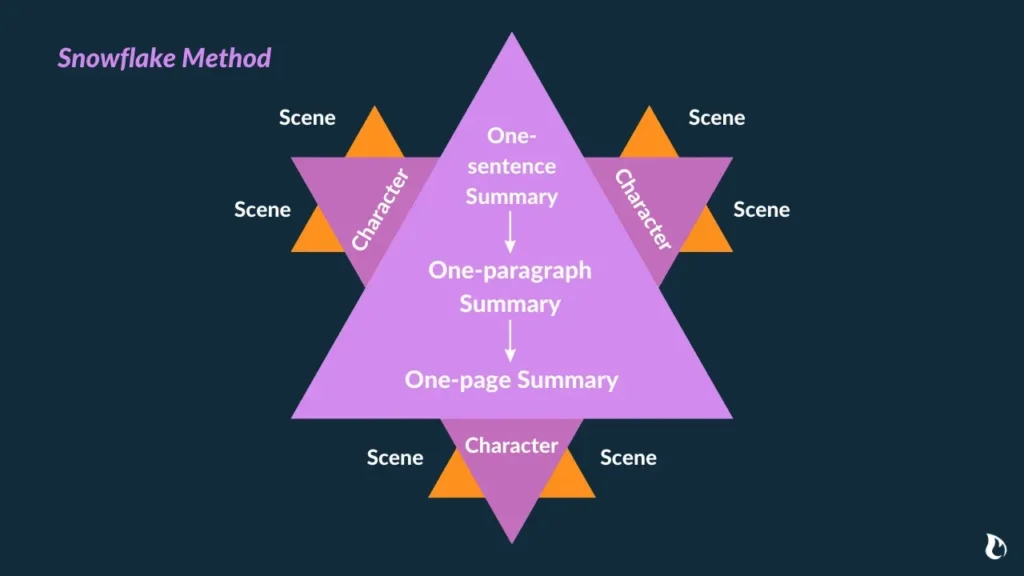
This is less of a story structure and more of a way of building one from almost nothing.
You start small: one sentence, then a paragraph, then characters, then scenes, then something that slowly begins to resemble a full outline. The whole idea is expansion. You take a tiny seed and keep growing it outward until the story becomes visible.
I can see why this writing framework works so well for some people. If you think best in abstractions first, if you need to understand the shape of the novel before you can write an actual scene, it gives you a sense of order very early on. That can be reassuring, especially when the project feels too large or too slippery to hold in your head all at once. It also helps expose weak premises quickly. If the story starts collapsing when reduced to a paragraph, that usually tells you something useful.
I’ve found it helpful in certain moments, usually when the draft feels too undefined and I need to pin down what the book is really about. Compressing the novel into something small has a way of revealing where the idea is strong and where it is still foggy. Expanding it again can be just as revealing, because you start seeing where the logic strains or where the emotional arc feels thinner than you thought.
What makes me cautious with this method is how easily outlining can begin to impersonate writing. You can spend hours refining summaries, adjusting structural lines, building character arcs on paper, and feel productive while never quite entering the actual language of the book. Then, when it is finally time to draft, the scenes can feel overdetermined, as if the life has already been organised out of them.
For me, this story structure tool works best when I use it lightly, almost as an early sketch rather than a blueprint. Enough to clarify the shape, not so much that the novel starts feeling pre-chewed. Especially with something atmospheric or psychologically dense, too much control too early can flatten the strange parts, and those strange parts are often the reason the book exists.
Use it for: clarifying a vague idea, especially when a project feels too large or messy to approach directly. It’s a useful writing framework for getting the bones of the story into view.
Don’t use it for: mistaking a polished outline for a living draft. You can build a very elegant structure on paper and still end up with pages that never quite breathe.
The Framework Most Writers Ignore
11. Scene and Sequel
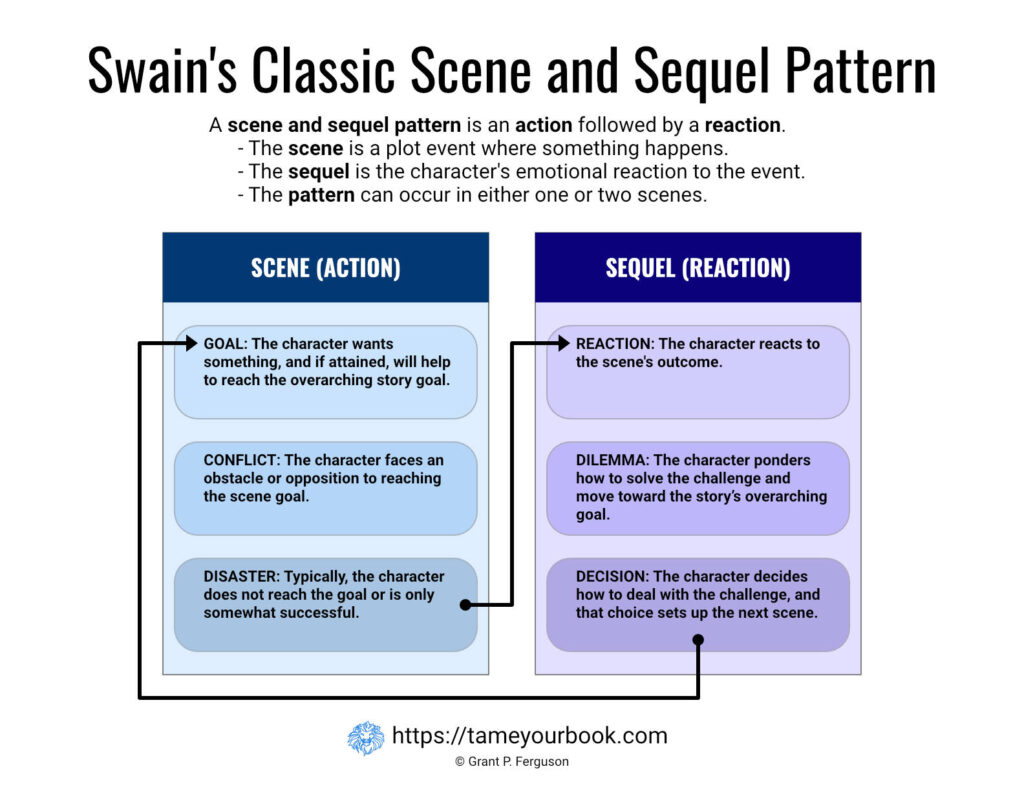
This is one of those writing frameworks that feels almost too simple when you first hear it, and then quietly fixes things you didn’t realise were broken.
A scene has a goal, conflict, and an outcome. A sequel is what happens after. Reaction, dilemma, decision. Then the next scene begins.
That’s it.
What surprised me is how often drafts lean heavily toward one side without noticing. There are plenty of scenes where things happen, characters move, tension exists, but nothing is processed. The story keeps pushing forward without ever pausing long enough for the character to absorb what just happened. It reads fine on the surface, but it doesn’t deepen.
The opposite happens just as often. Too much reflection, too much internal processing, too many pages where the character thinks, feels, considers, but nothing actually shifts in the world. That’s when the story starts to feel heavy in a different way. Slower, but not in a meaningful sense.
This story structure sits right in the middle of that problem.
It reminds you that action and consequence are not the same thing. A scene creates pressure. The sequel decides what that pressure does to the character. Without that second part, decisions start to feel arbitrary. Things happen, but the character isn’t clearly shaped by them.
I’ve found this especially useful in revision. When something feels slightly off but not obviously broken, it’s often because a key moment never had space to land. A character moves on too quickly, or reacts in a way that hasn’t been earned on the page. Adding a proper sequel doesn’t mean slowing the story down for the sake of it. It means giving the reader access to the shift that just occurred.
At the same time, it’s easy to overcorrect. If every scene is followed by long internal processing, the story can start to feel repetitive. Reaction, dilemma, decision, repeated too neatly, becomes its own kind of rhythm, and not always a good one. The balance matters.
Use it for: diagnosing why a story feels either rushed or stagnant, especially when character decisions don’t quite land. It’s a practical story structure for making sure events actually change something.
Don’t use it for: turning every chapter into a fixed pattern. As a writing framework, it works best when it stays flexible and supports the flow of the story rather than interrupting it.
The One That Tells You What Story You’re Writing
12. M.I.C.E. Quotient
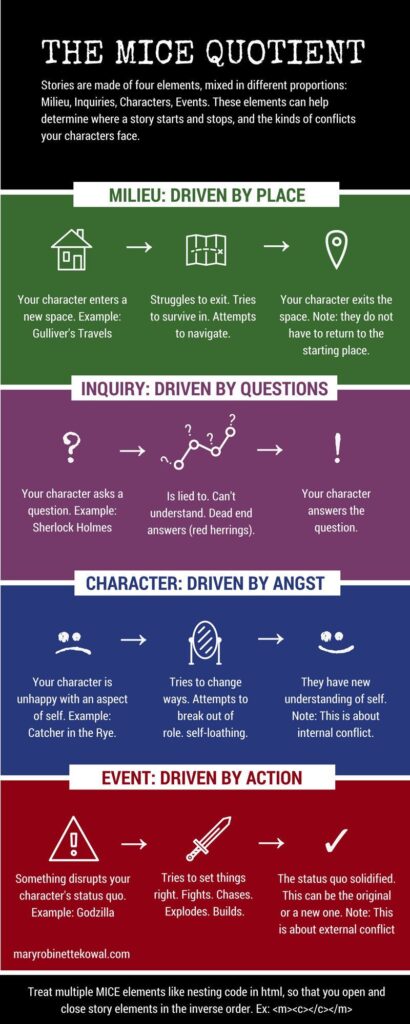
This is one of the few writing frameworks that doesn’t begin by telling you how to shape a story. It begins by asking what kind of story you’re dealing with in the first place.
Milieu, Inquiry, Character, Event.
Four different engines. Most novels borrow from more than one, but usually one of them is doing the deepest structural work, whether you meant for it to or not.
I was slow to appreciate this one. At first it felt a little too taxonomic, as if the last thing a draft needed was another label pinned to it. But it becomes surprisingly useful when a manuscript feels oddly misaligned. The scenes work. The voice works. The plot even works, technically. Yet the ending feels slightly wrong, or the middle seems to be pulling toward a different kind of book than the one you thought you were writing.
That often has less to do with pacing than with the story’s underlying engine. A Milieu story wants entrance and exit from a world. An Inquiry story wants an answer. A Character story wants inward change. An Event story wants disorder resolved. Those are not interchangeable desires. If the novel opens with one kind of promise and closes with another, readers feel the strain even if they can’t name it.
I’ve run into this more than once. A draft seems fine while I’m inside it, and then the ending starts resisting me. I keep trying to close it in a satisfying way and nothing quite clicks. Usually the problem isn’t that the plot is broken. It’s that the novel has quietly shifted its centre of gravity somewhere along the way, and I hadn’t noticed.
That’s where M.I.C.E. helps. Not because it hands you a solution, but because it gives you a clearer view of what the story has been asking for all along. It can also explain why a subplot sometimes feels cleaner or more complete than the main narrative. Subplots often know exactly what they are. The main story is the one trying to be three things at once.
Use it for: figuring out what your novel is structurally trying to do, especially when the ending feels slightly off or the book seems to lose its shape halfway through. It’s a very useful writing framework for getting the story’s internal logic back into focus.
Don’t use it for: reducing the novel to one tidy label too early. Most books have mixed DNA, and part of the work is noticing which strand matters most.
The Editorial Lens
13. Story Grid
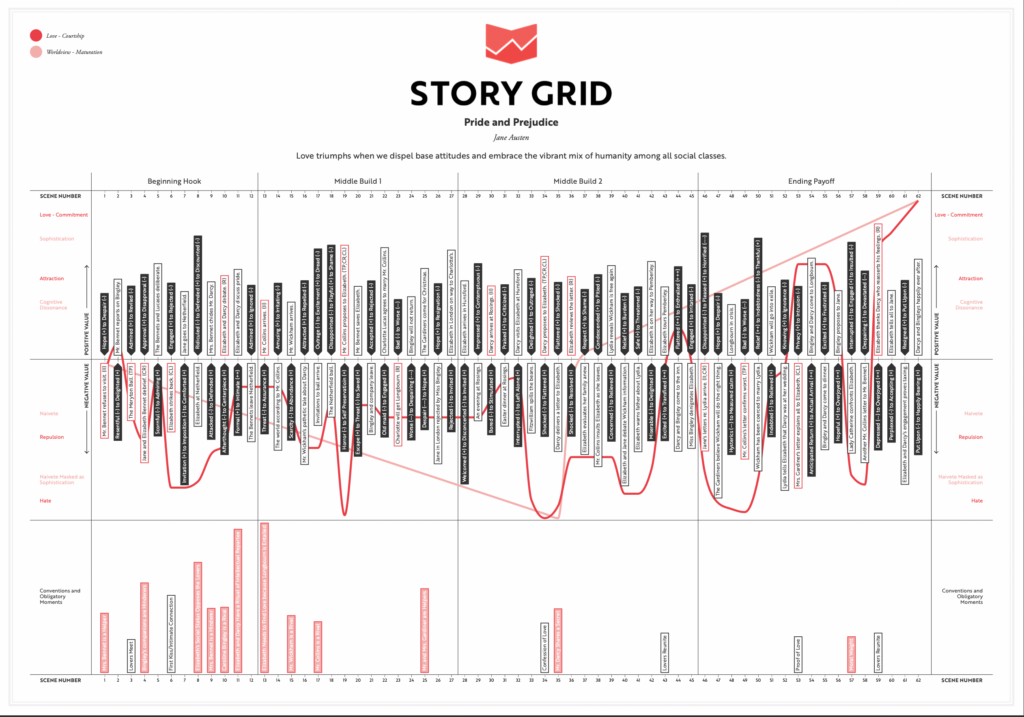
This is less a story structure and more a way of looking at a draft when you no longer trust your instincts.
Which happens more often than people admit.
Story Grid breaks things down at a very granular level. Scenes, beats, value shifts, genre expectations. It treats a novel almost like a system that can be examined piece by piece. That can feel a bit cold at first, especially if you’re used to writing more intuitively. It asks you to step back and look at the mechanics without the usual attachment.
I resisted it for a while for that reason.
But it becomes useful the moment you’re staring at a manuscript that feels wrong and you can’t explain why. Not in a vague sense, but in a way that keeps you from making progress. You reread chapters, move scenes around, tweak sentences, and nothing really improves.
Story Grid gives you a different entry point.
Instead of asking whether a chapter is “good,” it asks what actually changes in that scene. What value shifts from beginning to end. If nothing changes, the scene may be well written, but it isn’t doing structural work. That sounds obvious, but it’s surprisingly easy to miss when you’re deep inside your own prose.
It also brings genre into the conversation in a more direct way. Not as a marketing label, but as a set of expectations. Certain types of stories carry certain promises. If those promises aren’t met, something feels off, even if the writing itself is strong. That can be uncomfortable, because it forces you to decide what kind of story you’re actually telling.
The limitation is that it can pull you too far into analysis. If you stay in that mode too long, the writing starts to feel engineered. You begin thinking in grids instead of scenes, and that distance shows up on the page.
I tend to use it in specific moments. Usually late in the process, when intuition has taken me as far as it can and I need something more precise to understand what’s failing.
Use it for: breaking down a draft that isn’t working and identifying where scenes lack movement or where the story isn’t delivering on its own expectations. It’s a very detailed writing framework for revision.
Don’t use it for: early drafting or over-controlling the story. It works best once you already have something alive on the page and need help seeing it clearly..
So… Which Story Structure Should You Use?
This is the wrong question.
A better one is:
What problem am I trying to solve?
- If your story has no shape → start with Three-Act to orient yourself, then use Seven-Point to map it
- If your character feels flat → use Story Circle or Hero’s Journey to test their transformation
- If your pacing drags → look at Fichtean Curve or Scene/Sequel
- If your ending feels wrong → check MICE and see if your story type and ending actually match
- If your story feels mechanical → loosen the structure, or experiment with softer approaches like Kishōtenketsu
Most of the time, you’ll end up combining them.
Final Thoughts
The more I write, the less I believe structure is something you “get right” once.
It changes with the book. Sometimes the problem is pacing. Sometimes it is point of view. Sometimes the plot is functioning, but the character still is not moving in a way that feels true. A framework can help you spot that faster. That is usually enough.
I’ve been thinking about this a lot while editing Other Island. It’s a dystopian alternative history novel with a neurodivergent protagonist trying to survive inside a matriarchal system that presents itself as logical, moral, necessary, and still somehow makes less sense the closer you get to it. That kind of story puts pressure on everything at once: structure, character, worldbuilding, voice. It has taught me that a story can be carefully built and still need to breathe.
So that’s probably where I land with all of this. Learn the frameworks. Use them. Steal from them. Test your draft against them when something feels off. Then go back to the story itself, because that’s where the real work is.
If you want to read more about Other Island, you can find it here:

Leave a Reply