

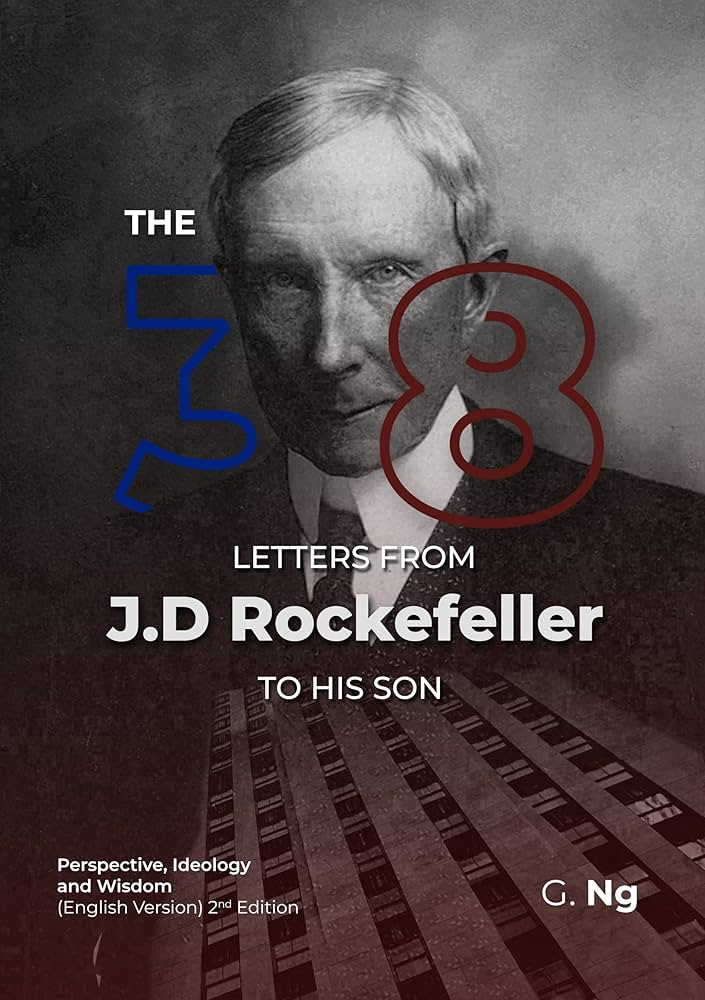
Doing research for a novel is hard work, to say the least. If you want to tell an accurate, complex story, you gotta dig deep, and not only for scientific or economical accuracy, but also for character accuracy. Since my dystopian series includes a handful of the elite, I created a comprehensive curriculum that would help me understand the bourgeoisie part of our society better. Starting with the usuals, like “48 laws of power” or “Prince” by Machiavelli, ending with more peculiar sources like J.D. Rockefeller’s personal letters to his son, where he shares his secrets to success.
I have talked to many people who have failed in their business and have heard countless reasons and excuses for failure. When those losers were speaking, they would often unwittingly say: “To be honest, I didn’t think it would work.” “I felt uneasy before I started.” “In fact, it’s not too surprising that this has failed.”
Adopting an attitude of “I will give it a try, but I don’t think there will be any results” will lead you to failure in the end. “Disbelief” is a negative force. When you disagree or have doubts in your mind, you will come up with various reasons to support your “disbelief”.
Who is J.D. Rockefeller?
The richest man of the 20th century, the inspiration behind The Simpsons’ Montgomery Burns and a magnet for conspiracy theories, John D. Rockefeller is, at the core, something simpler and more interesting: an American entrepreneur who built an oil empire from scratch.
Born in 1839, he lived to 97, which means he watched the United States transform from a young industrial nation into a modern superpower. He started working as a teenager, became obsessed with efficiency and numbers, and eventually co-founded Standard Oil, the company that reshaped how energy was produced, transported, priced, and controlled.
J.D. Rockefeller was the definition of a self-made man, starting off as a promising accountant, coming from a modest background, having only good things to say about his boss. Rumored to be an ISTJ.
Depending on who is telling the story, Rockefeller is either a ruthless monopolist or a disciplined builder who mastered scale before anyone had a name for it. Both versions contain truth. He used aggressive tactics, he crushed competitors, and he also engineered systems, logistics, and financial discipline so effective that they outlived him. Later, he turned enormous wealth into enormous philanthropy, helping fund universities, public health initiatives, and scientific research.
But I am not here to argue whether he was a hero or a villain.
I am here for the most practical part of his legacy: the way he thought.
Why do people hate J.D. Rockefeller?
When journalist Ida Tarbell her landmark investigation into Standard Oil in 1902, the public got its first clear picture of exactly how the machine worked — and they were furious. Her father’s oil business had been one of the casualties. She wasn’t writing mere theory. She was writing from personal experience.
The hatred also has a class dimension that still resonates today. Rockefeller became the richest man in modern history while his workers lived in company towns with limited resources. The wealth felt obscene because the gap was obscene. When the Supreme Court finally broke up Standard Oil in 1911, it was less a punishment and more an acknowledgement that one man had accumulated a degree of economic power that a democracy shouldn’t tolerate.
And then there’s philanthropy — which, depending on your perspective, either redeems him or makes him worse. He gave away hundreds of millions. He funded the University of Chicago, built public health infrastructure that saved countless lives. Critics argued, then and now, that this was reputation laundering on a grand scale. That you don’t get to reshape civilization through ruthless accumulation and then buy your way into sainthood.
The Villain or the Hero?
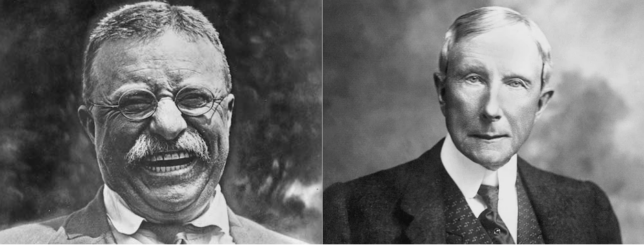
Theodore Roosevelt is widely regarded by historians as one of the best U.S. presidents, truly loved by the masses. For many, he was considered a hero, but to J.D. Rockefeller he was a villain, as he wrote in his letter to his son:
Frankly speaking, the mention of Theodore Roosevelt’s name and everything he did to Standard Oil makes me indignant. He is the narrowest and the most vengeful villain I have ever seen. Yes, this villain succeeded. With the power in his hands, he became the winner in an unfair competition that was initiated by him. The federal court issued the huge fine that was unprecedented in American history and ordered its dissolution of our company. See what this despicable man has done to us!
As a writer, this was especially interesting to me. While Roosevelt is widely regarded as a hero, and Rockefeller as a villain, from his own point of view Roosevelt was a narrow and vengeful villain. It gives you the best insight into complex characters based on real people.
Now, keep in mind that this quote sadly is not verified, and you can read more about it in the following sections.

The greatest reward for our work is not what we get, but what we will become.
FAKE J.D. Rockefeller
J.D. Rockefeller’s Lessons to his Son
This book consists of 38 letters J.D. Rockefeller wrote to his son over the course of 1887 to 1922. The accuracy of these letters is still debated, speculating that part of it might be fictional. Copies of his letters had been sent to China, but not all the details have been verified.
Either way, it’s the spirit of these letters that I want to talk about, and share the lessons mentioned in them:
However, passive people do not regard failure as an opportunity for learning and growth, as they are always admonishing themselves: perhaps I really can’t do it, so that is why I have lost my eagerness to participate in future activities.
And:
Optimistic people will see opportunity in suffering, and pessimistic people will see suffering in opportunity. Son, remember the formula of success that I believe in:
Dream + Failure + Challenge = Success
Lessons from an American business tycoon or random Chinese guys?
Upon further inspection it became clear with almost full certainty that indeed these published letters by JD Rockefeller were a fabrication by the Chinese, inspired by research on JD Rockefeller, some foundation on the real letters and also various self-help books.
There are several lessons here, one of them being that even with the high rated published books, not just online media, it’s important to verify everything you read.
The second lesson here is that I felt inspired by the idea that JD Rockefeller was this earnest, hard working, genuine man. I’m not sure if he was or wasn’t, but what I do know is that I did get inspired by these Chinese guys, and they were the ones who somehow restored my faith in humanity a little. Even if it was fake.
The Verified Correspondence Between J.D. Rockefeller and His Son
There are various sources with the verified J.D. Rockefeller’s letters, such as this PBS source.
If you compare these letters to the fictional ones, you can find a very down-to-earth language, such as this one:
Hotel Bon Air
Augusta, Georgia
January 18, 1909Dear Son:
I thank you a thousand times for the fur coat and cap and mittens. I did not feel that I could afford such luxuries, and am grateful for a son who is able to buy them for me. Be assured that they are much appreciated. Mother unites with me in thanking you.Affectionately,
Father
All that aside, let’s look at the lessons we can take from this book—
On the Importance of Failure
Fake J.D. Rockefeller talks a lot about the importance of failure, and how without it success doesn’t exist. In his letters he shares this story about Edison:
Ten years ago, a young reporter from The New York Sun interviewed him, and asked: “Mr. Edison, your current invention has failed 10,000 times. What do you think of this?” Edison was very immune to the word failure. He said to the reporter in a wise manner: “Young man, your journey of life has just begun, so I tell you that will help you a lot in the future. I have not failed 10,000 times, I just invented 10,000 unworkable methods.” The power of spirit is always so great.
On Talent Being Useless
There is nothing in the world that can replace perseverance. Talent is not acceptable. Unprecedented talents abound, and geniuses who accomplish nothing is common; education is also not acceptable. The world is full of people who are useless in learning. Only perseverance and determination will never be disadvantageous.
On the Importance of Faith
It is faith that illuminates my path, constantly gives me courage, and makes me face life positively. At any time, I never forget to increase my confidence. I replace the thought of failure with the belief of success. When I face a difficult situation, I think of “I will win” instead of “I might lose”. When I compete with people, I think of “I am as good as them”, not “I can’t compare with them.” When opportunities arise, I think of “I can do it” instead of “I can’t do it.”
On Human Greed
But I know that these is a kind of power hidden in human nature, one that grows in places lacking ability and will, that is jealousy. When you surpass them, they will hate you, accuse you using derogatory words, fabricate lies to slander you, and at the same time they will be very arrogant in front of you – in my opinion, that is not arrogance, it is just weakness. What’s interesting is that when you are far inferior to them, and your life is unbearable, they will laugh at you again, for being incompetent, stupid, and even belittle you to the point that you have no human dignity. My son, this is human nature!
Those who want to slander me, seemingly as if they are moral watchmen, which one of them would not want to monopolize what they have? Who does not want to control all the good things? Who does not want to control everything that everyone needs? There are always many hypocritical people.
In fact, as long as the world that wants to chase fame and fortune is not destroyed, as long as happiness does not become as easy to get as air, human being cannot stop being greedy.
Let us look at the philanthropies we have done today. Investing huge wealth in education, medicine, churches, and those in need is definitely not a place for me to do charity on a whim. It is a great charity, and the world is becoming more beautiful because of my success. It seems that greed is very good, and not a crime.
There is no free lunch in the world. If you want to make a person disabled, just give him a pair of crutches. If you give someone a free lunch for a certain period, he/she will develop the habit of getting something for nothing. Those who eat lunch for nothing, will sooner or later pay the price.
FAKE J.D. Rockefeller
On Being Smart and Foolish
People without knowledge are ultimately useless, but those without knowledge are likely to become slaves of knowledge.
A person who is smart is a fool, and a person who knows how to play a fool is really smart. If smartness is regarded as a criterion for reaping benefits, then I am obviously not a fool.
Playing stupid brings you many benefits. The meaning of pretending to be stupid is to stay a low profile and become humble, in other words, to hide your cleverness. The smarter the person, the more necessary it is for them to play stupid, because as the saying goes – the more mature the rice, the more they sag.
The reality is harsh, you have to be tougher, but obviously you also have to be a good person.
Fake j.d. rOCKEFELLER
On Excuses
Ninety-nice percent of the failures come from people who have the habit of making excuses.
In my opinion, “excuses is a mental illness, and people with this serious illness are all losers without exception.
The first action that the loser takes to settle later events is to find various reasons for their failure.
Occasionally, I have seen someone stand up and say: “I succeeded by my own efforts.” So far, I have not seen any man or woman dare to stand up and say: “I am the one who made myself fail.”
The most common excuse is health related. The sentence “my health is not good” or “I have this kind of illness” becomes a reason not to do it or to fail. In fact, no one is completely healthy, and everyone will have some physical problems.
People who think that they are stupid are really stupid. They should know that if a person does not consider the question of talent at all, and has the courage to try, he will be able to do well.
Interest and enthusiasm are important factors that determine success or failure.
I believe that an average-talented person who has an optimistic, positive and cooperative attitude towards the world will earn more money and win more respect as compared to a talented but pessimistic, passive and uncooperative person.
For me, second place is no different from last place.
FAKE J.D. ROCKEFELLER
Second place is the first loser—that was a phrase I grew up with, and I made one of my characters grow up with as well. Certainly this one has played a role in many households.
On Revenge and Insults
Revenge on others is an attack on yourself. Mr. Morgan did not seem to understand this truth, but in order to relieve his anger, he insisted let you control it instead. But in any case, even though Mr. Morgan blatantly insulted me, he always kept his eyes on the goal to be achieved, which I do admire.
My son, we grew up in a society that pursued dignity, and I know that it means to be insulted to a person who loves dignity. But in many cases, no matter who you are, even the President of the United States of America in unable to prevent insults coming from others.
So, what should we do? Do we fight back in rage and defend our dignity? Or is it to be tolerant and generous? Or do you respond in other ways?
So, I want to say that humiliation is not a bad thing. If you are a person who knows how to reflect calmly, you might think that humiliation is a measure of ability.
I sure would enjoy living in this parallel reality where the businessmen really live by these principles.
John, in your negotiations with Mr. Morgan, when it comes to money, you must never mention the amount first, but provide him with precious value and emphasize what he can buy from you.
FAKE J.D. ROCKEFELLER
On Controlling Your Emotions
John, there are too many people and things that require us to be patient in this world, and they entice us to be emotional. Therefore, you have to cultivate your ability to manage your emotions and control your emotions, and you should be careful not to be influenced by your emotions when making decisions, but instead make decisions based on your needs and always know what you want.
Only when you can endure what people cannot, can you then do what people cannot do.
Fake j.d. rockefeller
On Mindset
This vividly shows the difference between mindsets:
Before I started working with Roger, I tested him with a question. I said, “Mr. Roger, what do you think the government can do to abolish all prisons in thirty years?” He was confused when he heard it, and suspected that he had heard it wrong. After a while of silence, he began to refute me:
“Dear Rockefeller Sir, do you mean to release all the murderers, robbers, and rapists? Do you know the consequences of doing this? If that’s the case, we will not have peace. In anyway, there must be a prison.”I wanted to smash Rogers’ monolithic head, and I reminded him: “Roger, you only said the reasons why prison cannot be abolished. Now, try to believe that the prison can be abolished. Assuming it can be abolished, how should we proceed?”
“This is too hard for me, Mr. Rockefeller, I can’t believe it, and it’s hard for me to find a way to abolish it.” This is Rogers’ method – no way.
I cannot imagine how he will use all his talents to actively react when he is given a heavy responsibility, or when an opportunity or a crisis hit. I do not trust Roger; he will only turn hope into hopelessness.
When we believe that something is impossible to do, our brain will find various reasons for us not to do it. However, when we believe—really believe that something can be done, our brain will help us find various ways.
What’s the takeaway from this?
I might have been tricked into reading a book that wasn’t JD Rockefeller’s letters to son, but it did teach me a few crucial lessons:
- Even seemingly credible things can be fake. Even published books featuring prominent names, with plenty of positive reviews. Even government marked locations, e.g., Socrates Prison, might be not authentic.
- Sometimes the best things come from unexpected places. I thought it was JD Rockefeller inspiring me, but those were two Chinese guys altering my brain chemistry. either way—a win is a win.
I continued my research into JD Rockefeller based on facts, though nothing was honestly as interesting as this creation of fiction. It painted a story that I was sad to learn wasn’t quite true.
With all that in mind, I continue with doing massive research every week (every day!) for my novel, as well as due to unlimited curiosity, and getting ready for publishing my dystopian dark fantasy novel.
If you’d like to get an email when it’s published, check it out here.

Leave a Reply