

Agatha Catchrain · Writing Advice
David Mamet in his writing MasterClass said that authors tell themselves they can’t write because they don’t know these 100 things about their character — and he called that procrastination. And while I am a firm believer in depth when it comes to character psychology, I somewhat agree. I used to love the 100-things exercise, but when it comes to real depth, you get far better results when you focus on the few most important things.
Here’s the catch though: you’ll probably need to go through all 100 before you can figure out which 10 actually matter.
Spoiler alert: includes possible spoilers for Babel and The Secret History.
#1&2 What Do They Want, and What Do They Actually Need?
These two always go together, because they only make sense in relation to each other — so I’m treating them as one.
The want is external and surface-level, and it needs to be clear from the first page. According to many story structure theories, the want shifts around the catalyst or debate stage. In Babel, Robin starts off wanting to survive, then his want transforms into wanting to succeed at Babel. In The Secret History, Richard starts off wanting to escape his ordinary life, then his want transforms into wanting to join that exclusive group.
The need is different. It’s internal, and it becomes apparent through the story. It’s connected to the theme.
While Robin wanted to succeed at Babel, what he needed was to stop mistaking conditional acceptance for love. Richard needed to learn that exclusivity does not equal moral worth.
#3 What is Their Problem?
Another thing you need to know about your character is their problem.
Not the external problem they’re dealing with. The internal problem that is externally visible.
Only when a reader opens the book and on page one it’s already clear what the character’s problem is — have you truly figured out your character.
When you start reading Babel, Robin’s obsession with belonging is immediately present. He’s trying to balance fitting in across contradictory worlds at the same time. In The Secret History, you can feel Richard’s hunger to feel special from the very first pages, his desire to be part of something exclusive to the point it starts destroying him.
#4 What is Their Contradiction?

Have you seen the Hannibal series? Hannibal Lecter played by Mads Mikkelsen is the perfect example: a cannibal serial killer, yet the perfect aesthetic gentleman who sets the most gorgeous dinner tables.
That contradiction creates permanent cognitive tension. You’re never quite sure which version of the character is the real one — and that uncertainty is exactly what keeps you watching. The character doesn’t make sense, yet somehow they do. That’s what makes them compelling.
#5 What is the First Thing They Notice?

Another thing you need to know about your character is what they notice first.
Every character has their own prism. They see the world differently.
One character walks into a room and immediately clocks who’s wearing the most expensive clothes, who might be the most important person there. Another walks into the same room and, out of hyper-vigilance, maps all the possible exits in case something goes wrong.
You don’t need to overcomplicate this. Pick a few core principles and stay consistent.
#6 What Are Their 3 Values — and Which One Would They Sacrifice?

It’s not just important to know your character’s values. It’s important to know which one they’d be willing to give up — and then, during the story, make them give it up.
Say your character values truth, doing the right thing, and their career as a journalist. Then they uncover a disturbing secret that forces a choice: warn people and lose their job, or keep the job and pay with their conscience.
That’s the kind of pressure that reveals who someone actually is.
#7 What is Unique About Their Voice?

If you want your character to be truly memorable, they need a voice that belongs only to them. It can be a combination of things — catchphrases, the richness of their vocabulary, sentence rhythm, syntax habits.
One character might speak in a densely intellectual way with a dry, morbid sense of humour. Another might be relentlessly sunny, dropping self-deprecating jokes at every opportunity. The voice should feel inevitable for who they are.
#8 What is Their Core Misbelief?

Another thing you need to know about your character is their core misbelief.
The core misbelief is often what drives the entire plot.
In The Secret History, Richard is convinced his worth depends on belonging to this exclusive group. A misbelief might be that love is conditional on being useful — and the story is the long, painful process of the character discovering that isn’t true.
#9 What Past Event Created That Misbelief?

The misbelief usually traces back to something specific. A wound. An event that made the world make more sense when interpreted through that particular lie.
Maybe the character was abandoned young, and the lesson they took from it — consciously or not — was that love has to be earned. It doesn’t need to be dramatic. It needs to be specific enough to explain why this particular misbelief, for this particular person.
#10 What is Their Third Rail?

This is my favourite one, and the one I think about most.
The third rail is the dangerous current running under the whole character arc. It’s where the character’s want, need, wound, and misbelief all touch the same live wire at once.
The want is what they consciously chase. The misbelief is the lie shaping how they chase it. The need is the truth they’re not ready to face. The third rail is the point where all three start pulling against each other.
Without it, events can happen to a character without meaning anything. With it, every major plot point pressures the same hidden wound until the character can no longer keep living by the old logic.
My favourite example is Eren in Attack on Titan. He starts with a clear, burning want: kill all Titans. Then the story turns the knife — he finds out he is a Titan himself.
That’s third rail storytelling. The plot doesn’t just complicate his goal. It turns his goal against his identity. The thing he’s dedicated his life to destroying is now part of him. If Titans are monsters, what does that make him? If the enemy is inside him, what does revenge even mean?
That’s why that reveal hits the way it does. It’s not just a twist. It’s a direct attack on the psychological foundation of the character.
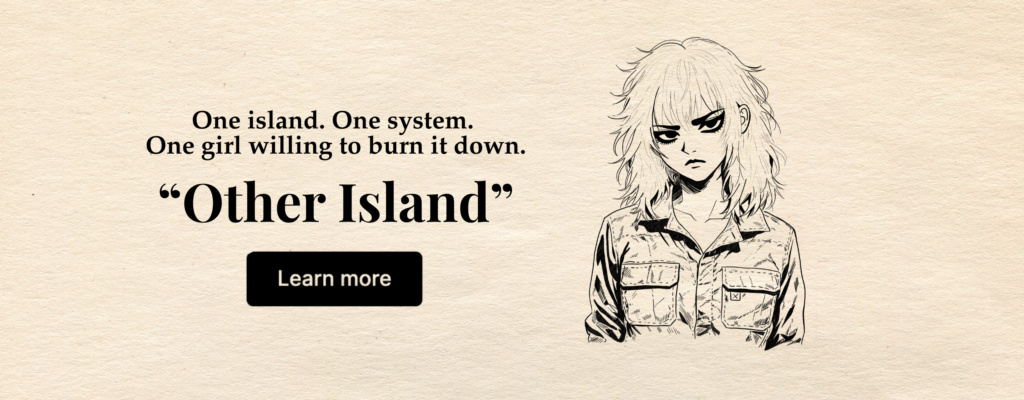
In Other Island, each of my three POV characters has their own version of this. The want pulling them forward, the misbelief steering them wrong, and the moment when the story forces all of it to collide. Building that collision is the part of writing I find hardest — and most worth doing.
What’s Next?
Answering these questions is not a one-time thing. As your story develops and gets more specific, it’s worth coming back to all of these and rethinking them. What you think your character believes on draft one is rarely the whole picture.
Other Island has three POV characters, each with a distinct voice, a different set of values, and a journey that mirrors the others’ in unexpected ways — despite the fact that they’re completely different kinds of people. If that sounds like your kind of book, you can learn more here.

Leave a Reply