
I write dystopian fiction. So I have a strange relationship with criticism.
I want it. A novel without criticism is either dead, protected, or not being read carefully enough. At the same time, the longer I spend around books and online literary spaces, the more I notice that not every “review” is actually reviewing the book.
Sometimes reviewers use reviews to quench their thirst for feeling superior. They use them as an excuse for pseudo-intellectual bullying. But I wanted to look at it from an academic point of view, by putting it into a linguistic framework.
I chose R. F. Kuang’s Katabasis as my case study. Partly because it has attracted exactly this kind of polarised reception. Partly because katabasis is an ancient Greek word for descent into the underworld — a journey downward through darkness toward something that changes you — and I’ve been sitting with that word while writing Other Island, which is in many ways its own katabasis: a girl descending into a system she cannot survive unchanged, with deep Ancient Greek lore. So the subject felt personal in more than one way.
More than anything, I wanted to start my linguistic analysis journey with R. F. Kuang — and not simply because she wrote Babel, a novel about linguistics. It’s because for some reason people consistently try to cancel her over every possible excuse, and I wanted to look for linguistic bias, digging into people’s need to prove that liking something they hate makes someone less worthy. This is just the first article in a series of linguistic pieces, and as I continue, I’ll write more connecting the dots between linguistics, psychology, and other related fields, hoping to shed light on the human nature behind this phenomenon.
Now, let’s get deeper into the linguistics of those reviews.
Method: what I counted
A note on the sample: I looked at ten 1-star reviews, prioritizing the most recent and longest ones — the ones where someone clearly sat down and meant it. That selection probably skews the findings toward more formal, text-focused criticism. The shorter reviews tend to be rawer and more personal. If the full pool had been included, the loaded language numbers would likely look worse, not better.
The one sentence 1star reviews look like this:
is this considered clever these days
or
this book cured my chronic insomnia
or
Kuang writes voluminously decorated fake plastic trees.
For the ten 1-star reviews of Katabasis that I selected, I coded the evaluative language according to three targets:
- The book/text itself
- R. F. Kuang as author
- Fans/audience
I deliberately excluded evaluations of Kuang’s previous books, general publishing discourse, the reviewer’s own emotional experience where it was not directed at the book, and comparisons to unrelated works.
The unit of analysis was not a whole review. It was an evaluative unit, meaning a phrase or clause that carries judgment.
For example:
“The prose is clunky.”
That is one evaluative unit, directed at the book.
“Kuang thinks she is smarter than her audience.”
That is one evaluative unit, directed at the author.
“Fans only like this because it is R. F. Kuang.”
That is one evaluative unit, directed at the audience/fans.
This matters because one review can contain legitimate craft criticism and loaded personal judgment in the same paragraph.
For the linguistic framework, I used Monika Bednarek’s model of evaluation, especially categories such as emotivity, reliability, style, comprehensibility, importance, expectedness, and possibility/necessity. Bednarek’s work is useful because it treats evaluation as linguistic expression of opinion, rather than simply “positive” or “negative” sentiment.
I also used Appraisal Theory, especially the distinction between Appreciation of a text, Judgement of a person, and Affect as emotional response. Appraisal Theory is built around Attitude, Engagement, and Graduation, which makes it useful for analyzing how writers express evaluation, certainty, and intensity.
Finally, I used ideas from stance and engagement analysis and Critical Discourse Analysis, especially where reviewers position themselves as clear-eyed critics and position the author, book, or fans as naïve, fraudulent, smug, or manipulated. Hyland’s stance and engagement model is useful for seeing how writers construct relationships with readers, while van Dijk’s ideological-square model helps explain positive self-presentation and negative other-presentation.
The first result: most criticism is still aimed at the book
The dataset came to 235 evaluative units total.
Here is the breakdown by target:
| Target | Negative | Positive | Mixed | Total |
|---|---|---|---|---|
| Katabasis book/text | 161 | 13 | 3 | 177 |
| R. F. Kuang / author | 45 | 7 | 0 | 52 |
| Fans / audience | 5 | 1 | 0 | 6 |
| Total | 211 | 21 | 3 | 235 |
The first thing to say is important:
Most of the criticism is directed at the book.
That matters because it keeps the analysis honest. The reviews are not simply “attacks on the author.” Many of them do what reviews are supposed to do. They criticize prose, structure, character work, pacing, originality, emotional force, worldbuilding, and narrative logic.
A reviewer saying:
“The pacing is slow.”
is criticizing the book.
Or:
“The characters lack depth.”
is criticizing the book.
Or:
“The prose feels overwritten.”
is criticizing the book.
These may be harsh, but they are ordinary literary evaluations. They belong to what Appraisal Theory would call Appreciation, meaning evaluation of an object, artwork, text, or performance.
The problem begins when the criticism shifts from:
The book does not work.
to:
The author is smug.
The author is condescending.
The author is performing intelligence.
The fans are pretending to like it.
Figure 1: positive and negative evaluative units by Bednarek category
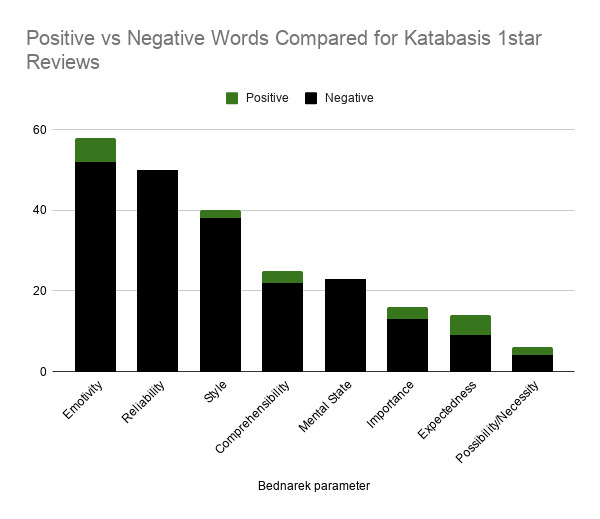
The most frequent category is Emotivity.
That is expected. These are 1-star reviews. People are angry, bored, irritated, exhausted, disappointed, or disgusted. Reviews are emotional genres. Goodreads especially is not an academic journal. It is part reading diary, part public performance, part literary court.
But the second most frequent category is more revealing:
Reliability: 50 negative evaluative units, 0 positive.
Reliability is not just about whether the book is “good” or “bad.” It is about whether the book is framed as genuine or fake, earned or unearned, serious or performative, deep or pretending to be deep.
Reliability: the language of “fake depth”
The strongest pattern in the dataset is not simply that reviewers dislike Katabasis. It is that many reviewers describe the book, or Kuang herself, as inauthentic.
fake intellectual
self-insert
performative
hollow
unearned
spectacle, not critique
pretending to be profound
confusing provocation with depth
not trusting the audience
trying to show intellectual superiority
They do not simply say:
The argument is underdeveloped.
They say:
The book is pretending.
The author is pretending.
The intelligence is fake.
The depth is fake.
The politics are fake.
The academic setting is fake.
A clear review might say:
The academic setting does not feel fully integrated into the plot mechanics.
A loaded review says:
This is fake intellectualism.
A clear review might say:
The novel states its themes too directly.
A loaded review says:
Kuang thinks her readers are stupid.
Figure 2: target of evaluation
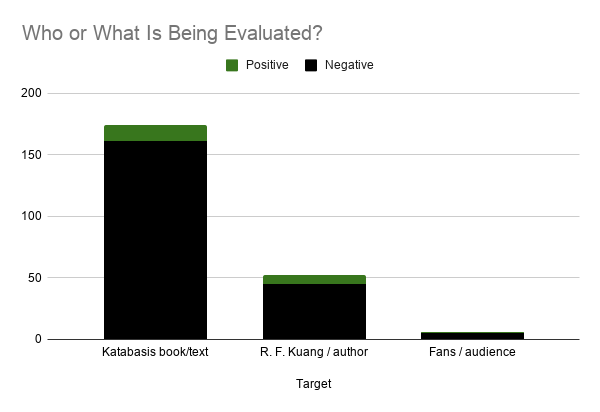
This chart is important because it shows the shift from text to author. The author-directed evaluations are fewer than book-directed ones, but they are much more linguistically charged.
The author becomes the object
The dataset contained:
52 author-directed evaluative units
45 of them negative
Negative author-directed language often does not merely say:
Kuang’s craft did not work for me.
It suggests things about her mind, motives, ego, class position, or intellectual sincerity.
This is an Appraisal Theory shift from Appreciation to Judgement.
Appreciation evaluates the book:
The prose is clunky.
The pacing is uneven.
The worldbuilding is thin.
Judgement evaluates the person:
She is condescending.
She is smug.
She is congratulating herself.
She thinks she is smarter than the audience.
When a reviewer says:
The book is didactic.
they are evaluating the text.
When a reviewer says:
Kuang does not trust her audience.
they are attributing motive.
When a reviewer says:
She wants to show how intellectually superior she is.
they are constructing an authorial persona.
The Judgement language in these reviews often moves into territory a reviewer cannot actually access: motive, ego, class position, intellectual sincerity. A reviewer can know what a book does. What they cannot truly know is why the author did it.
So when a review says she wanted to lecture or she does not trust readers or she is congratulating herself, it has moved from textual evidence into motive attribution. That is a stronger and less neutral move than craft criticism. It asks the reader to judge the author’s character, not just her book.
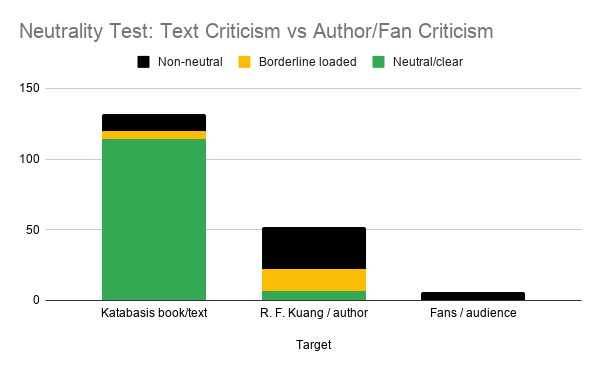
Figure 3: neutrality test by target
The neutrality test
Book-directed criticism: mostly negative, but often still grounded in textual observation. A lot of it passes the neutrality test.
Author-directed criticism: much more likely to become loaded, to attribute motive, to make claims about sincerity and ego that go beyond what the text can actually show.
Fan-directed criticism: 6 units, all 6 non-neutral. Every single one. That is not surprising.
Once a review stops discussing the book and starts discussing the people who like the book, it usually becomes less analytical.
Fan-directed criticism tends to rely on phrases like:
people only like this because
fans are pretending
readers are fooled
BookTok made this happen
no one really thinks this is good
It is about social delegitimation.
It tells the reader:
Do not trust the people who liked this.
That is one of the strongest ways to influence opinion without appearing to argue directly against the book.
You do not have to prove the book is bad if you can make its admirers look stupid.
The social story inside the reviews
The implicit story often looks like this:
I am the clear-sighted reader.
The book is pretending to be profound.
The author is performing intelligence.
The fans are fooled by reputation, politics, or hype.
Van Dijk’s ideological square is useful here: in ideological discourse, speakers tend toward positive self-presentation and negative other-presentation. The reviewer’s “self” is rarely named explicitly in a Goodreads review, but it is implied throughout. The discerning reader. The one who was not taken in. The person who saw through the hype.
Most linguistic bias is probably not deliberate. That is actually what makes it interesting. A reviewer may genuinely believe they are just being honest. Honesty can still use loaded words. It can turn discomfort into certainty, and suspicion into evidence. Especially online, where criticism is also performance.
The difference between strong criticism and loaded criticism
I want to be clear about something: I am not arguing that negative criticism is the problem.
Authors need serious negative criticism. A culture where every book must be praised because of the author’s identity or politics is not a literary culture.
Strong criticism and loaded criticism are genuinely different things, and it is worth being able to tell them apart.
Strong criticism:
This scene does not work because the emotional turn is not prepared.
Loaded criticism:
The author clearly thinks she is a genius.
Strong criticism:
The prose is too abstract, so the setting never becomes physically real.
Loaded criticism:
This is fake intellectual nonsense.
Strong criticism gives the book somewhere to stand trial. Loaded criticism poisons the courtroom before the trial begins.
What the data actually shows
The main finding is simple:
Bias is not proven by negativity. Bias appears when negativity shifts targets, intensifies beyond evidence, attributes motive, attacks authenticity, or delegitimizes the audience.
In this sample, most evaluative units were negative — expected for 1-star reviews. Most were aimed at the book — fair. The revealing patterns appeared in the author-directed and fan-directed language.
The book-focused criticism mostly stayed within recognisable literary categories: prose, pacing, depth, structure, comprehensibility. The author-focused criticism moved into motive, ego, sincerity, and authenticity. The fan-focused criticism was almost entirely delegitimising.
The sentence “I did not like this book” is literary criticism.
The sentence underneath it — and anyone who did must be fooled, pretentious, morally captured, or worshipping the author — is something else.
That is a little ideology, wearing the coat of taste.
What’s next?
This is just the first article in a series of linguistic analyses of Goodreads reviews. I’ll continue with other books by R. F. Kuang, such as Poppy War and Babel, and build a compilation of deeper linguistic analysis of how people review R. F. Kuang as an author, using loaded language to reveal bias. I’ll then move on to analysing reviews of other authors, such as Margaret Atwood, N. K. Jemisin, George Orwell, Dostoevsky, Alex Michaelides, and more. If you’d like to be notified when the next article is out, you can subscribe to my newsletter.
And just like Katabasis, Other Island is a dark academia novel with strong Ancient Greek lore, set in a matriarchal world where WW1 never happened — with Dionysian frenzies, a fight for justice, and a revenge story in the spirit of The Count of Monte Cristo. If that sounds like your kind of book, you can learn more and subscribe for updates via email.


Leave a Reply