
Agatha Catchrain · Writing Advice
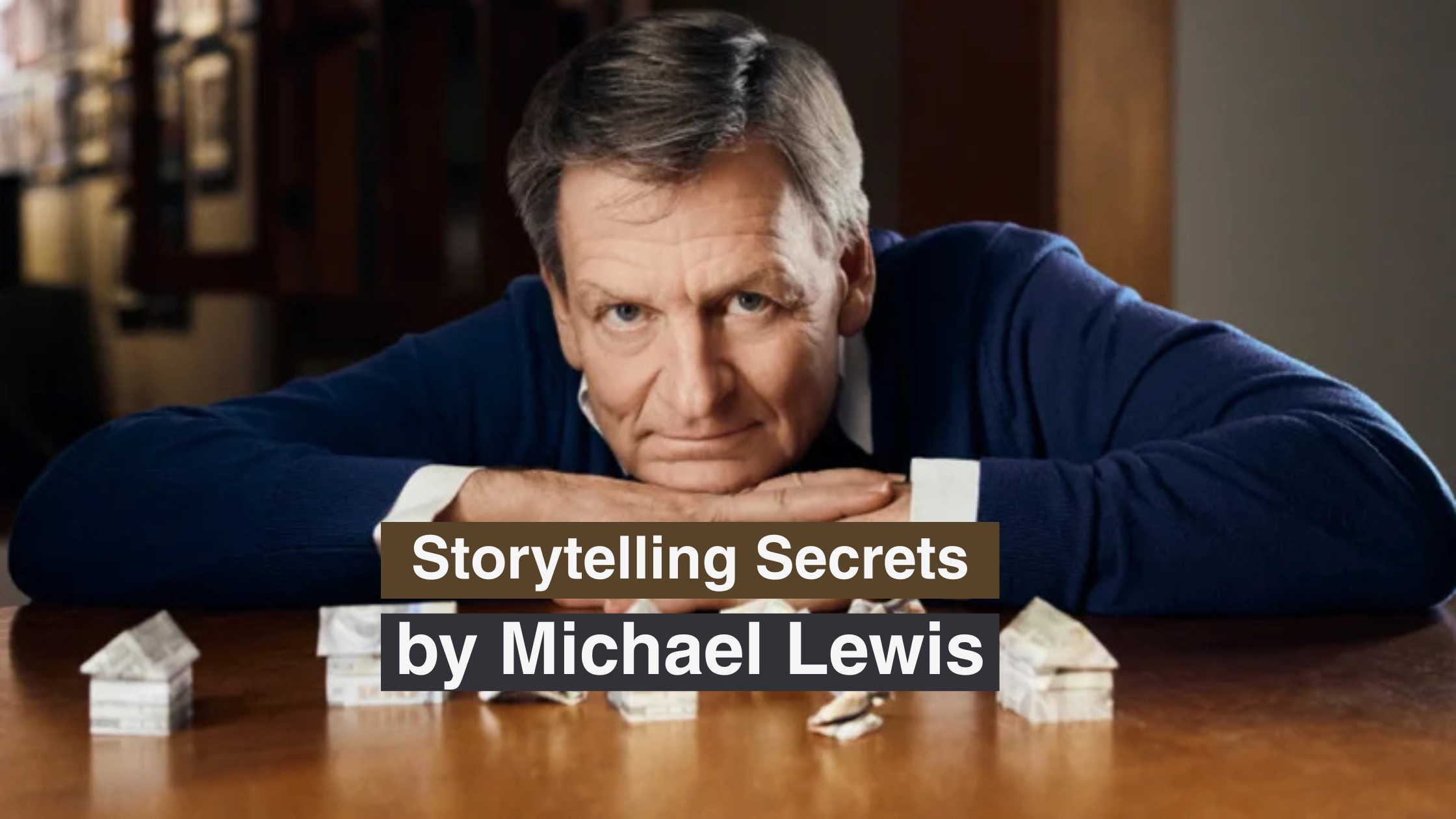
Still on my MasterClass binge. This time: Michael Lewis.
Author of Moneyball, The Big Short, The Blind Side. Twenty books. Three of them turned into Oscar-nominated films. The kind of writer you either already know, or you’re about to spend the next week reading everything he’s ever written.
His course is called Tell a Great Story – and it’s less about writing specifically and more about how to make anyone care about anything. A book. A speech. A pitch. A conversation at a dinner party where you don’t want to be boring.
Here’s what stayed with me.
Write for one person who loves you
This is his trick for finding your voice, and I’ve been thinking about it ever since.
Lewis says: when you sit down to write, imagine you’re writing to someone who already loves you. He pictures his mother. It can be anyone, as long as it’s one person who is completely on your side.
Because here’s what happens when you write for a crowd – you self-edit before you’ve started. You hedge. You perform the version of yourself that feels safest. And nothing interesting ever came from safe.
Writing for someone who loves you bypasses all of that. You stop trying to impress anyone and just start talking. Which is, weirdly, when your actual voice shows up.
I’ve been doing something similar without realising it. The scenes in Other Island I’m most proud of are the ones I wrote fast, for myself, having real fun with it, when I’d stopped caring whether they were good.
The story is never about what it looks like it’s about
Moneyball is not about baseball.
The Big Short is not about the financial crisis.
The Blind Side is not about American football.
This is Lewis’s biggest idea and also the one most writers resist. We think the subject is the story. It’s not. The subject is the vehicle. The story is always about people – specific, strange, particular people – and the larger thing gets in through them.
People keep on dissecting what makes some novels bestselling, while others are not. Just recently I read this comment on Reddit saying that all post-2010 dystopian novels failed, because unlike Handmaid’s Tale or 1984, they didn’t tackle a social problem happening right now, but as Margaret Atwood said: she doesn’t think Handmaid’s Tale is her best book, it’s simply that the world somehow went in that direction. My point is: there are hundreds of theories on what makes a book go big, but one thing that is stronger than anything else is the story of human beings, on a deep, personal level.
Pick the unexpected character
For The Big Short – a book about the global financial crisis, one of the most written-about events of the 21st century – Lewis figured there were roughly 15 people he could have built the story around.
He picked Michael Burry. Hedge fund manager, glass eye, Asperger’s diagnosis, listening to heavy metal in his office while making bets the entire housing market was about to collapse.
Not the obvious choice. That’s exactly why it works.
The unexpected character forces the reader into a perspective they didn’t know they needed. People come for the subject. They stay for the person. And the person makes them see the subject in a way no obvious choice ever could.
Just like with comedy, and a little teaser from the comedy Masterclass I’m watching with Steve Martin – it’s all about the unexpected. That’s what makes it fun.
The best advice he ever gave anyone
Put your ass in the chair.
That’s it. That’s the whole thing. The biggest secret to writing.
Similar to what Wayne Gretzky said, that you miss 100% of the shots you don’t take, you also don’t write the novel if you don’t put your ass in the chair. Unless you’ve mastered writing while walking.
(Been there, done that)
I’m going by this principle while writing Other Island — a dark archaeological alternative history novel about a woman in a matriarchal world who has to make an impossible choice when her sister is selected as the next sacrifice.
I get my ass in the chair. Every morning. And write, and write, and write. Not skipping a day.
I guess, Michael Lewis would approve.
If that sounds like your kind of book, subscribe to my newsletter to get an email when it’s out.


Leave a Reply